From Ownership to Access: The Quiet Transformation of Gaming
Cloud gaming made me realize something unsettling: the games I play, and even the save data representing my time in them, may never exist on my own system. Gaming may be the clearest example of a broader shift—where ownership is slowly being replaced by access.
As an avid gamer, I’m always on the lookout for something new to play. This past weekend I was browsing Xbox Game Pass, hoping to find a good couch co-op game for my wife and me to enjoy together.
A couple of titles caught my eye. Perfect. Included with Game Pass. No extra purchase required.
I clicked on one to install it…
Except there was no Download button.
The only option available was “Play with Cloud.”
Curious, I gave it a try. Within minutes I knew it wasn’t for me. The experience was glitchy and laggy in ways that make couch gaming frustrating instead of relaxing.
But what bothered me even more wasn’t the performance.
It was the realization of what was actually happening.
The game wasn’t on my system.
Not even the save file representing my time in the game would exist on my system.
Everything lived somewhere else.
A Quiet Shift
This isn’t just about one Game Pass title. It’s part of a broader trend that has been slowly reshaping the gaming industry for years.
Think about how things used to work.
You bought a game for $60.
You got a physical disc.
You put it in your console.
And you played it.
No internet required. No servers involved. The experience existed entirely in your living room.
Your save files lived on your memory card or hard drive. The game worked whether the company that made it still existed or not.
You owned the thing you paid for.
But over time that ownership has been quietly chipped away.
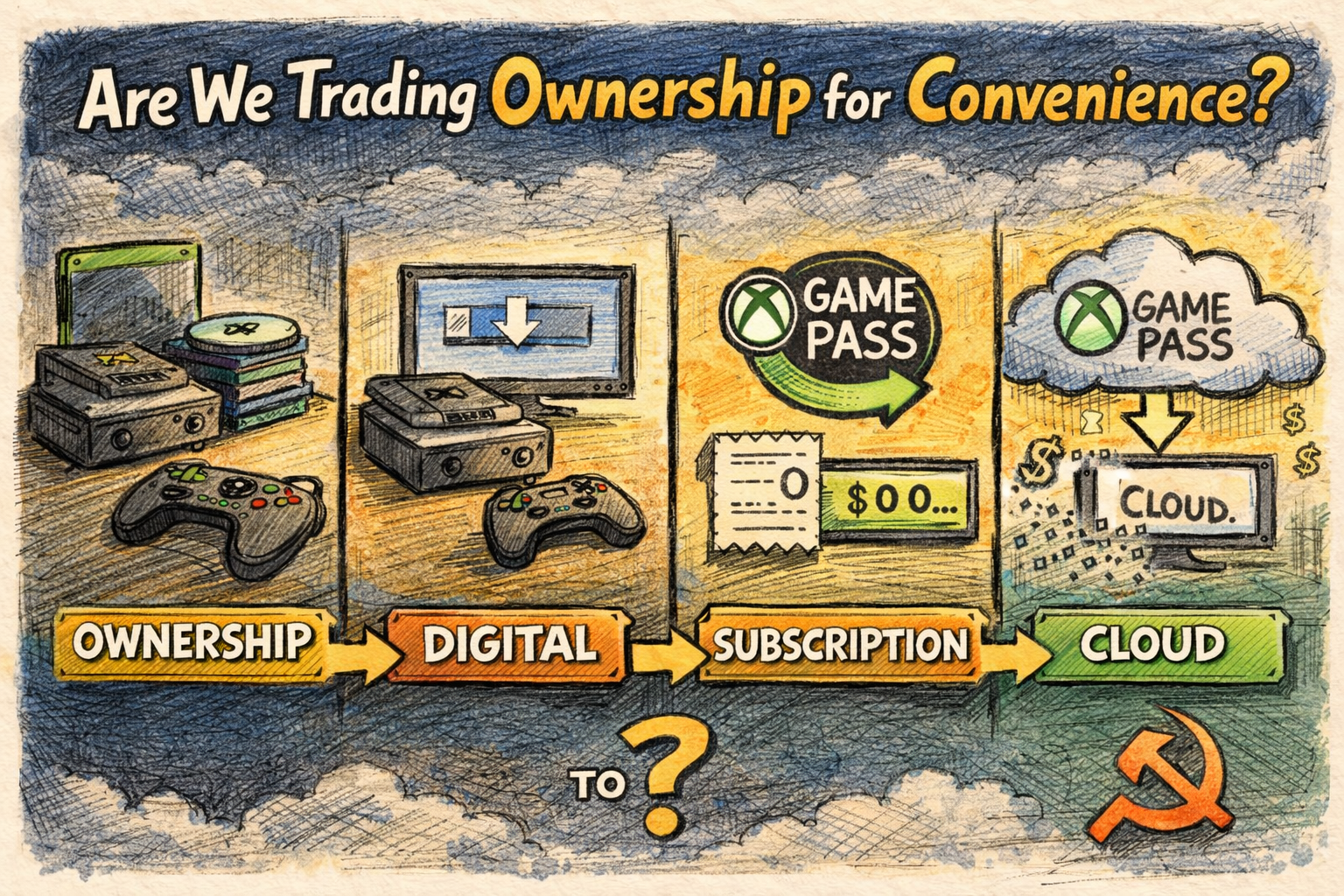
First came digital downloads.
Then came always-online requirements.
Then came subscription services.
Now we’re approaching something even more abstract: games that don’t exist on your device at all.
You’re just streaming them from somewhere else.
Ownership vs Access
Cloud gaming flips the traditional model on its head.
You’re no longer buying a product.
You’re buying access to a service.
And access can be revoked.
Servers shut down.
Licensing agreements expire.
Platforms decide to remove titles.
If that happens, the game doesn’t just disappear from the store.
It disappears from your life.
Even your save data—the digital record of the hours you invested—can vanish with it.
This Isn’t Just About Gaming
At first glance, this might seem like a small thing. After all, it’s just a video game.
But the more I thought about it, the more it felt like something bigger.
Gaming is just one example of a much broader shift happening across Western society.
We used to own things.
- Music came on CDs or vinyl.
- Movies came on tapes and discs.
- Software came on installation media.
- Games came on cartridges and discs.
Now almost everything has become a service.
Music is streaming.
Movies are streaming.
Software is subscription-based.
Games are streamed from the cloud.
Even things like cars, home appliances, and tractors are increasingly locked behind software restrictions, remote activation, and licensing agreements.
In many cases, we’re no longer buying products.
We’re paying for temporary permission to use something someone else controls.
Ownership Is Independence
Ownership has always mattered because it gives people independence.
If you own a book, you can read it whenever you want.
If you own a game, you can play it whenever you want.
If you own software, you can run it whether the company that made it still exists or not.
But when everything becomes a service, that independence disappears.
Access can be revoked.
Servers shut down.
Licenses expire.
Accounts get banned.
Platforms change their terms.
And suddenly something you thought you owned simply disappears.
The Slow Cultural Shift
What’s fascinating is how quietly this transition has happened.
No one voted for it.
No law forced it.
Instead, it crept in slowly through convenience.
Streaming is easier than buying discs.
Subscriptions feel cheaper than large upfront purchases.
Cloud gaming removes the need for powerful hardware.
Each individual step seems reasonable.
But taken together, they move society in a direction where fewer and fewer people own the things they rely on.
A Question Worth Asking
Gaming made me notice it because the change feels so obvious there.
But the bigger question might be this:
If ownership continues to disappear across more and more parts of life… what kind of society do we end up with?
One where individuals own less, control less, and rely more heavily on large institutions to grant access to the things they need.
Maybe that future is fine; though, I'm scared for our future (there seem to be a lot of dark forces pulling in all directions).
Maybe the convenience is worth it; though, is it so bad to put in effort?
But it’s a question worth asking before we get there.
Because once ownership disappears… getting it back might be impossible. I'm fan of the American dream, and ownership and private property is a bedrock for that dream.